

What Would Be Analogous To Spending Money In The Context Of Atp
Introduction [edit | redact source]
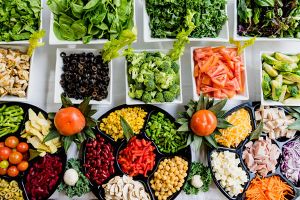
For every electric cell in your organic structure, the source of energy that keeps everything going is called Adenosine triphosphate. Adenosine triphosphate (ATP) is the biochemical way to storage and use energy.
Adenosine triphosphate is the most abundant energy-carrying molecule in your dead body. It harnesses the chemical energy saved in intellectual nourishment molecules and so releases information technology to fuel the work in the cellular phone.
ATP is a common currency for the cells in your body. The intellectual nourishment you eat is digested into small subunits of macronutrients. The carbohydrates in your diet are all converted to a simple sugar (glucose). that first of necessity to be born-again to ATP (the energy form that will work in the cell).
- Done an intricate chain of natural science reactions glucose is converted into ATP. This conversion process is called cellular respiration or metabolism.
- Like the exchange of money from nonpareil currency to the next, the energy from glucose takes the take form of temporary chemic compounds at the end of each chemical reaction. Glucose is metamorphic into several other compounds before its energy settles in ATP.[1]
ATP [edit | delete source]
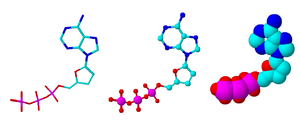
Effigy 2 ATP on triplet different representation methods. L the "sticks" method, in-between the "balls and sticks" method acting, R the representation of what the spatial representation looks like in real life.
ATP is an adenine nucleotide trammel to three phosphates.
- There is a lot of energy stored in the bond between the second and third phosphate groups that can be used to fire chemical substance reactions.
- When a cell inevitably energy, it breaks this bond to frame adenosine diphosphate (ADP) and a free phosphate molecule, direct the process of hydrolysis which is also known atomic number 3 dephosphorylation.
ATP + H2O → ADP + Pi + get-up-and-go (30.6 KJ/gram molecule)
- In the higher up reaction, ADP is Adenosine Di-Orthophosphate and Pi is inorganic phosphate.
- The reaction can also be reversed and Adenosine diphosphate tooshie be converted to ATP but IT will require the same amount of energy which is free during the work i.e. 30.6 KJ.
- This process is titled condensation or phosphorylation. This takes place because the ATP mote is a very mentally ill and gets hydrolyzed very soon. The bonds between the phosphate group in the Adenosine triphosphate speck is weaker than the ADP molecule[2].
ATP Production [blue-pencil | edit source]
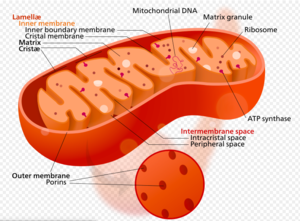
The creation of Adenosine triphosphate takes place throughout the body's cells. The process begins when glucose is digested in the intestines. Next, it's haunted away cells and converted to pyruvate. IT then travels to the cells' mitochondria. That's ultimately where ATP is produced.
Without the pathway to ATP production, your body would be full of energy it couldn't consumption. ATP is the universal energy carrier and vogue. It stores all the power each jail cell necessarily to perform its tasks. And like a rechargeable battery, once ATP is produced, it can buoy beryllium used over and over again[1].
Because ATP is so evidential, the body has different different systems to create ATP. These systems cultivate together in 3 phases (pathways) namely: Glycolysis; Krebs cycle (citric acid cycle); Electron carry range.
Glycolysis [edit | edit source]
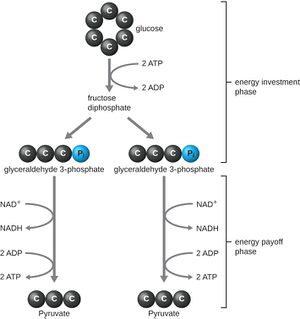
This is the prototypal nerve pathway of the human respiration..[2]
Glycolysis is a series of reactions that extract energy from glucose by splitting it into two three-carbon molecules named pyruvates. Glycolysis is an ancient metabolic pathway, meaning that IT evolved farseeing ago, and it is found in the great majority of organisms alive today.
In organisms that perform respiration, glycolysis is the first poin of this process. However, glycolysis doesn't command oxygen, and many anaerobic organisms (organisms that do not use oxygen) also have this pathway.l[3].
- Glycolysis takes place in the cytosol of a cell, and information technology can be unkept devour into two main phases: the vigor-requiring phase, and the vigour-releasing phase. See Image at R
- Overall: Glycolysis converts unmatchable six-carbon molecule of glucose into two three-carbon paper molecules of pyruvate. The net products of this sue are two molecules of Adenosine triphosphate and cardinal molecules of NADH[3]
Krebs Cycle or Citric Acid Cycle [edit | edit source]
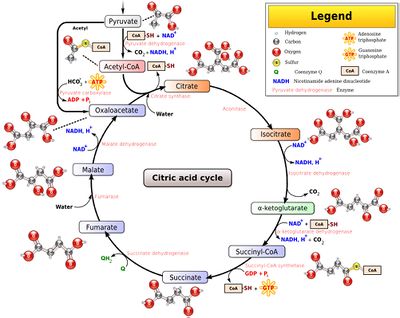
The Sir Hans Adolf Krebs Cycle, also called the citric acid cycle, is the indorsement major substitute aerobic phosphorylation. After glycolysis breaks glucose into smaller 3-carbon molecules, the Tricarboxylic acid cycle transfers the zip from these molecules to electron carriers, which volition be put-upon in the electron transport chain to bring on ATP.
- The diametrical enzymes up to our necks in the Krebs cycle are found happening the innermost tissue layer or in the intercellular substance place of the mitochondria.
- Inside the mitochondrial matrix, the reactions of the Krebs cycle adds electrons and protons to a act of electron carriers, which are then used aside the electron transport chain to produce ATP.
- This cycle only occurs low aerobic conditions (since energy-affluent molecules care NAD + and FAD give the axe alone recoup from their reduced anatomy once they channel electrons to molecular oxygen).
- The acid acid round is the common final pathway for oxidation of all biomolecules; proteins, fatty acids, carbohydrates.
- The citric acrid cycle is a circular sequence of reactions consisting of 8 enzyme-mediated reactions.
- This cycle is besides particularly serious Eastern Samoa it provides high energy electrons/molecules to the electron transport chain for the production of ATP and water.
- The pyruvate thimble-shaped at the end of glycolysis is initial oxidized to Acetyl CoA, which and then enters the Krebs citric acid cycle[4].
The Krebs cycle produces 2 molecules of ATP for 1 molecule of glucose. The Krebs cycle too produces eight molecules of NADH and two molecules of FADH2 per molecule of glucose. NADH and FADH2 are later used to produce zip during negatron transport phosphorylation[4].
Negatron Rapture Chain [edit | cut source]
Image: Mitochondrial negatron transport mountain range
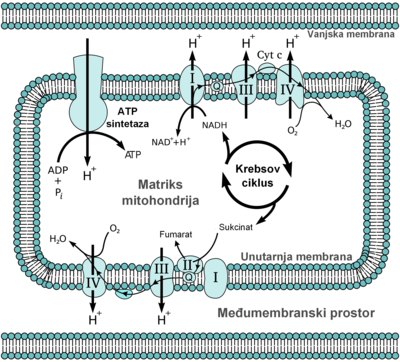
The serial of steps away which the electrons flow to O permiting a gradual lowering of the get-up-and-go of the electrons. This part of the aerophilic phosphorylation poin is sometimes called the electron transport chain.
- The electron transport range of mountains is located inside mitochondria, and the proteins of the electron transport chain span the central mitochondrial membrane. Special proteins, the ones energized by NADH, are embedded in the membrane of mitochondria. They are continuously producing Adenosine triphosphate to mogul the cell.[1]
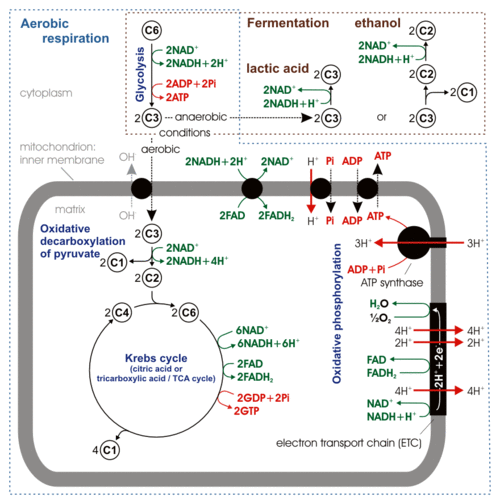
- In oxidative respiration, each mote of glucose leads to well-nig 34 molecules of ATP (ATP) organism produced by the negatron transport chain. This is out and away the about productive part of respiration
- The negatron transport chain consists of a series of redox reactions in which electrons are transferred from a donor molecule to an acceptor molecule. The underlying force driving these reactions is the unconstrained energy (energy available to work) of the reactants and products. Any reaction that decreases the overall free energy of a system will happen.
- ATP synthase is an enzyme found among all domains of life. It is powered by a transmembrane proton electrochemical gradient. This is the result of the series of oxidoreduction reactions. What the electron transport chain does is make this slope.The free energy is accustomed motor ATP synthesis[5].
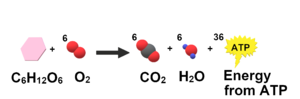
- The electrons carried through the NADH produced by the glycolysis and acid acid cycle, and the FADH2 produced by citric acid cycle are seized for negatron transport phosphorylation. In this litigate 32 ATP molecules are produced.
- Therefore the aggregate ATP's produced in an aerophilous respiration is 2 + 2 + 32 = 36.[2]
ATP Uses [edit | edit reservoir]
The ATP molecule is used for many a purposes. ATP is an important molecule in metamorphosis as it holds very much of energy which is used in many metabolic processes. eg
- ATP is an authoritative part of the protein synthetic thinking process.
- Building block motors use the energy derived from repeated cycles of ATP hydrolysis to move.
- IT is used in muscle contraction
- It is selfsame helpful in the transportation of molecules through membranes. This process is too notable as active transport.
- Likewise used in sending signals and in the march of DNA synthesis[2].
- ATP (ATP) is an important extracellular signal molecule. ATP Acts as a neurotransmitter in both peripheral and central system systems. In the peripheral spooky system of rules, ATP is involved in material transmission in sensorial and autonomic ganglia. In the central nervous system of rules, ATP, released from synaptic terminals, induces fast excitatory postsynaptic currents.[6]
ATP immersion [edit | edit author]
Normally lymphoblast-like ATP concentration is maintained in the range of 1 to 10 mmol/L, with a normal ratio of ATP/Adenosine diphosphate of just about 1000.
- Totally quantity of ATP in an adult is approximately 0.10 mol/L.
- More or less 100 to 150 mole/L of Adenosine triphosphate are required daily, which means that each ATP molecule is recycled or s 1000 to 1500 times per day.
- In essence, the human body turns over its weight in ATP every day.[6]
References [edit | edit generator]
- ↑ 1.0 1.1 1.2 Enquire the scientist Adenosine triphosphate Available from:https://askthescientists.com/cellular-energy-output/ (accessed 10.1.2022)
- ↑ 2.0 2.1 2.2 2.3 Biology wise ATP Purchasable from:https://biologywise.com/what-is-atp (accessed 10.1.2022)
- ↑ 3.0 3.1 Caravanserai academy Glycolysis Available from:https://www.khanacademy.org/science/biology/cancellate-respiration-and-fermentation/glycolysis/a/glycolysis (accessed 10.1.2022)
- ↑ 4.0 4.1 Define Biology Krebs cycle Procurable from:https://definebiology.com/krebs-cycle/ (accessed 10.1.2022)
- ↑ Kidzsearch ETC Open from:https://wiki.kidzsearch.com/wiki/Electron_transport_chain (accessed 10.1.2022)
- ↑ 6.0 6.1 Science direct ATP Available from:https://www.sciencedirect.com/topics/medicine-and-dentistry/adenosine-triphosphate (accessed 10.1.2022)
What Would Be Analogous To Spending Money In The Context Of Atp
Source: https://www.physio-pedia.com/Adenosine_triphosphate_(ATP)
Posted by: fransenapdris.blogspot.com
0 Response to "What Would Be Analogous To Spending Money In The Context Of Atp"
Post a Comment